Ireland also relies heavily on imported energy, with limited long-term storage. That means the system has less buffer than many people realise when supply is disrupted or demand suddenly increases.
For some, that means thinking differently about how they heat their home. For others, it’s about how exposed their business is to change. And for many in rural Ireland, it’s a reminder that the energy transition doesn’t look the same everywhere.
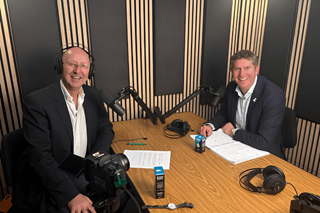
These were some of the themes explored by Duncan Osborne, CEO of Calor Ireland, in a recent episode of The Great Business Show Podcast. But the broader question behind that discussion is worth exploring further: What does a reliable, long-term energy system look like for Ireland?
Energy security is no longer a background issue
Ireland has long been exposed to external energy pressures. We import the majority of the fuels we rely on, with limited indigenous supply and relatively little long-term storage. This leaves the country more exposed than many others when supply tightens or demand spikes. For a long time, that reality sat in the background.
Today, it feels much closer to home. Homeowners notice it when heating costs become harder to predict. Businesses feel it when planning becomes more uncertain. And off-grid communities experience it most directly, with fewer fallback options if supply is disrupted.
What’s changed is awareness. Energy is no longer something people assume will simply be there when needed. It’s becoming part of longer-term thinking, whether that’s replacing an ageing boiler, reviewing fuel choices, or understanding how resilient a property or business really is.
It’s clear: energy security is no longer just a national concern. It’s something people are actively thinking about at household and business level.
Why one-size-fits-all thinking does not reflect Ireland’s reality
One of the biggest challenges in Ireland’s energy transition is how different the starting point is across the country.
A new build with modern insulation standards has very different options to a detached rural home built decades ago. A food producer with high, consistent heat demand operates very differently to a typical office. And for homes and businesses beyond the natural gas grid, decisions are shaped by what can realistically be delivered and maintained.
In many parts of the country, infrastructure simply doesn’t reach, and isn’t expected to in the near term. That’s where a single, uniform approach begins to fall short. Ireland needs long-term direction, but it also needs solutions that reflect how people actually live and work. Some properties can move quickly. Others will need a more gradual path. That’s not a flaw in the system. It’s the reality, and working with it is what makes meaningful progress possible.
What it means for homeowners
For homeowners, the shift is grounded in everyday experience.
People are asking:
- Is my current system still the right fit for this house?
- How much control do I have over my heating costs?
- If I need to upgrade, what’s realistic without major disruption?
For many older homes, particularly in rural areas, a full system overhaul isn’t usually the first step. What’s possible is shaped by insulation, layout and cost. A complete retrofit to a high-efficiency standard can run into tens of thousands of euro. While that may be the long-term goal, it’s not always something homeowners can take on immediately. In reality, most homeowners don’t replace their heating system until they have to, often when a boiler fails. That means decisions tend to be made under pressure, rather than as part of a planned upgrade.
As a result, many households are looking for options that:
- work with existing systems
- improve efficiency without major structural changes
- allow for a gradual move towards lower-carbon energy
In that context, LPG and BioLPG often come into the conversation. They offer a way to move away from more carbon-intensive fuels while maintaining a heating system that feels familiar, responsive and easy to manage.
What it means for businesses
For businesses, energy decisions are closely tied to continuity.
Hotels, food producers, farms and industrial operations all rely on consistent, controllable heat. For those outside the natural gas grid, that requirement becomes even more critical.
In sectors like food production, hospitality and agriculture, even short interruptions to heat supply can have a direct impact on output, quality or customer experience.
The focus is:
- Can the system meet demand consistently?
- Is supply reliable?
- Does it support sustainability targets without disrupting operations?
- Can it be planned and managed with confidence?
Many businesses are already moving away from heavier fuels such as oil towards gas-based systems, not just for emissions reasons, but for consistency, efficiency and control. For these customers, the decision isn’t simply about fuel. It’s about protecting output, managing cost and reducing operational risk.
The role of gas in the transition
Energy conversations can sometimes become overly binary: fossil or renewable, current system or future system, old model or new model. But most transitions happen in stages.
Particularly where high, consistent heat is required, alternatives are not always a direct replacement. That’s why gas continues to play a role alongside newer technologies.
For off-grid homes and businesses, LPG can provide a workable step away from higher-carbon fuels such as oil, coal or peat while maintaining the controllable heat many customers still rely on. For those looking further ahead, BioLPG offers a renewable alternative that works within the same system.
This creates a pathway. It allows customers to:
- move away from more carbon-intensive fuels
- reduce disruption
- maintain operational continuity
- adopt lower-carbon energy in stages
That phased approach is particularly relevant in Ireland, where buildings and businesses are starting from very different positions.
Keeping rural Ireland firmly in the picture
Any meaningful energy conversation in Ireland has to include rural Ireland.
Around two-thirds of homes are not connected to the natural gas grid. Many are older properties, often in more exposed locations, with very different heating requirements to urban housing. Farms and rural businesses face similar constraints, relying on consistent, dependable energy in areas where infrastructure is limited and unlikely to expand.
These aren’t gaps waiting to be filled, they’re different starting points.
A rural home may be harder to retrofit fully. A farm may depend on steady heat to keep operations running. A local business may need to stay where it is because that’s where its customers, supply chain or community are based.
That changes the conversation. It’s not just about what the future system looks like, but how to make progress in a way that works for each setting.
In these environments, energy needs to be reliable and suited to how the building or business operates. That’s where more flexible, distributed solutions, including LPG and renewable alternatives like BioLPG, continue to play an important role.
Planning ahead without losing sight of today
Ireland’s long-term direction is clear: more renewable energy, stronger infrastructure and lower emissions.
At the same time, homes and businesses still need dependable energy every day.
Bridging that gap means focusing on what can be done now, alongside longer-term ambition. It involves making decisions based on:
- what’s already in place
- what’s affordable
- what infrastructure exists
- and what each property or site actually needs
While long-term targets focus on decarbonisation, the immediate challenge for many customers is maintaining reliable, affordable energy today.
For Calor, that means supporting customers through that process, helping them make informed decisions today, while keeping future options open.
A more balanced energy future
Ireland’s energy future won’t be built around a single solution.
It will come from a mix of technologies, stronger infrastructure and a clearer understanding of how energy is used across homes, businesses and communities. The challenge is not just where the system is heading, but how to get there without losing reliability along the way.
That balance between long-term ambition and day-to-day reality is at the centre of the conversation.
To hear more on how Ireland’s energy landscape is evolving, and what it means for homes and businesses nationwide, you can watch the full discussion with Calor Ireland CEO Duncan Osborne here.



 }
}
 }
}
 }
}
 }
}
 }
}
 }
}
 }
}